
How to Choose the Right Cycling Jacket?

All year round, waterproof, thermal or windproof jackets are appreciated by road cyclists, gravel riders, bike commuters and mountain bikers alike. Compact and often essential, they have pride of place in the bag or on the shoulders of the well-prepared rider.
With or without an inner lining, purely waterproof, hybrid or simply windproof, their prices range from around twenty euros to over 350 euros for models featuring the most advanced technologies. Faced with this multitude of options, a casting mistake can turn a winter ride into an ordeal or a spring climb into a sauna.
It is therefore essential to choose the jacket best suited to your discipline, the weather and your physiology. Here are the technical and practical criteria to make the right choice.
In short: how do you choose your cycling jacket?
To make sure your cycling jacket purchase is the right one, ask yourself these three fundamental questions:
- Where and when will I ride? (Freezing winter = thermal insulation; Storms = waterproof rating > 15,000 mm; Cool mornings = packable windproof gilet).
- What is my discipline? (Road = Aero and stretch; MTB = Durability and a looser fit; Commuting = Visibility and maximum protection).
- How intense are my efforts? (Racing = Extreme breathability / low RET; Leisure rides = Comfort and warmth).
Then check the details that make the difference: the quality of the taped seams, how smoothly the zips run, the presence of underarm vents and reflective strips. A good, well-maintained jacket will literally transform your winter months in the saddle.
The technical criteria: Understanding how cycling jackets are made
Protection against the rain: Waterproofing and the membrane
Waterproofing is often the main criterion when buying a jacket, especially in mid-season or winter. It is expressed in "Schmerbers" and measured using the "water column" system. The protocol is simple: water is applied to the fabric of the jacket at increasing pressure via a tube. 1 Schmerber corresponds to the pressure exerted by 1 mm of water.
- From 2,000 to 5,000 mm: The jacket is water-repellent or very slightly waterproof. It will keep you dry if you have to face light showers or light drizzle for a short time.
- 10,000 mm (10,000 Schmerbers): This is the waterproofing standard. Such a jacket will keep its wearer dry in almost all regular rainy situations.
- 15,000 to 20,000 mm and above: The most high-end cycling jackets are designed to withstand these pressures. They are built for torrential downpours, violent storms and rides of several hours in pouring rain.
The Gore-Tex® label, found on many high-end jackets, is a historic guarantee of quality, combining several layers to create waterproof jackets without sacrificing ventilation. These microporous membranes prevent outside moisture from getting in, while letting inner moisture escape.
The move towards PFAS-free fabrics and new membranes: With new environmental regulations limiting the use of PFAS (forever pollutants) historically present in many waterproof membranes, manufacturers are rolling out highly effective alternative technologies. These include Polartec® fabrics such as NeoShell® (ultra-breathable, supple waterproofing) or Power Shield® (innovative weather protection, plant-based and PFAS-free). These alternatives guarantee excellent technical protection while limiting environmental impact.
Watch out for seams and the DWR treatment: A 20,000-Schmerber membrane is useless if water seeps in through the seams. Always check that the jacket has taped seams and waterproof zips. In addition, the outer surface of jackets is coated with a water-repellent treatment (DWR). Over time, this treatment fades. It is essential to reactivate it regularly with specific sprays (preferably PFC-free).
Protection against the wind: The windchill effect
The windproof effect is just as vital a criterion. On a bike, you create your own wind (the relative wind). At 30 km/h, an outside temperature of 5°C feels like 0°C to your body, and this cooling accelerates if you are wet with sweat. This is called convection.
Some windproof jackets can be more than enough to protect the rider on a trip out in mild temperatures (10–15 degrees). Labels such as "Windstopper®" (or Gore-Tex Infinium) are reliable indicators. Unlike a pure rain jacket, a 100% windproof jacket generally has no taped seams, but its huge advantage lies in its far superior breathability.

Take the temperature into account: Thermal insulation
In cold weather, blocking the wind and rain is no longer enough – you need to retain heat. Thermal cycling jackets (often called winter jackets or "softshells") are made with a brushed, fleece-like interior or insulating synthetic fibres. On the most advanced models, manufacturers integrate cutting-edge insulation such as PrimaLoft® (ultra-light, packable synthetic fibre, formidable against the cold) or Polartec® Alpha® (active insulation of military origin, designed to regulate heat and provide exceptional breathability during intense effort). However, temperature management on the bike comes down to the 3-layer rule: a technical base layer, a thermal jersey, and the jacket as the outer layer.
Match the jacket to the intensity of your effort: Breathability
It is fundamental that your jacket is breathable so you don't sweat excessively. Breathability is generally measured by the MVTR (Moisture Vapour Transmission Rate in g/m²/24h) or the RET (Thermal Evaporative Resistance). A RET below 6 indicates an extremely breathable jacket, ideal for intense efforts. Also think about mechanical venting (zips under the arms) to release excess heat.
Choose the right fit and mild conditions
A badly fitted jacket will have a disastrous "parachute effect" on aerodynamics and cause heat loss at the collar and cuffs. Check for an extended rear panel (drop tail) to protect your lower back from spray from the rear wheel. In mild temperatures and changeable conditions, an ultra-packable lightweight jacket or a sleeveless gilet provides protection from the wind with minimal bulk.
Choosing your cycling jacket according to your riding discipline
A jacket that is perfect for the road will often be unsuitable for MTB, and vice versa. The demands of the terrain dictate the characteristics of the garment.
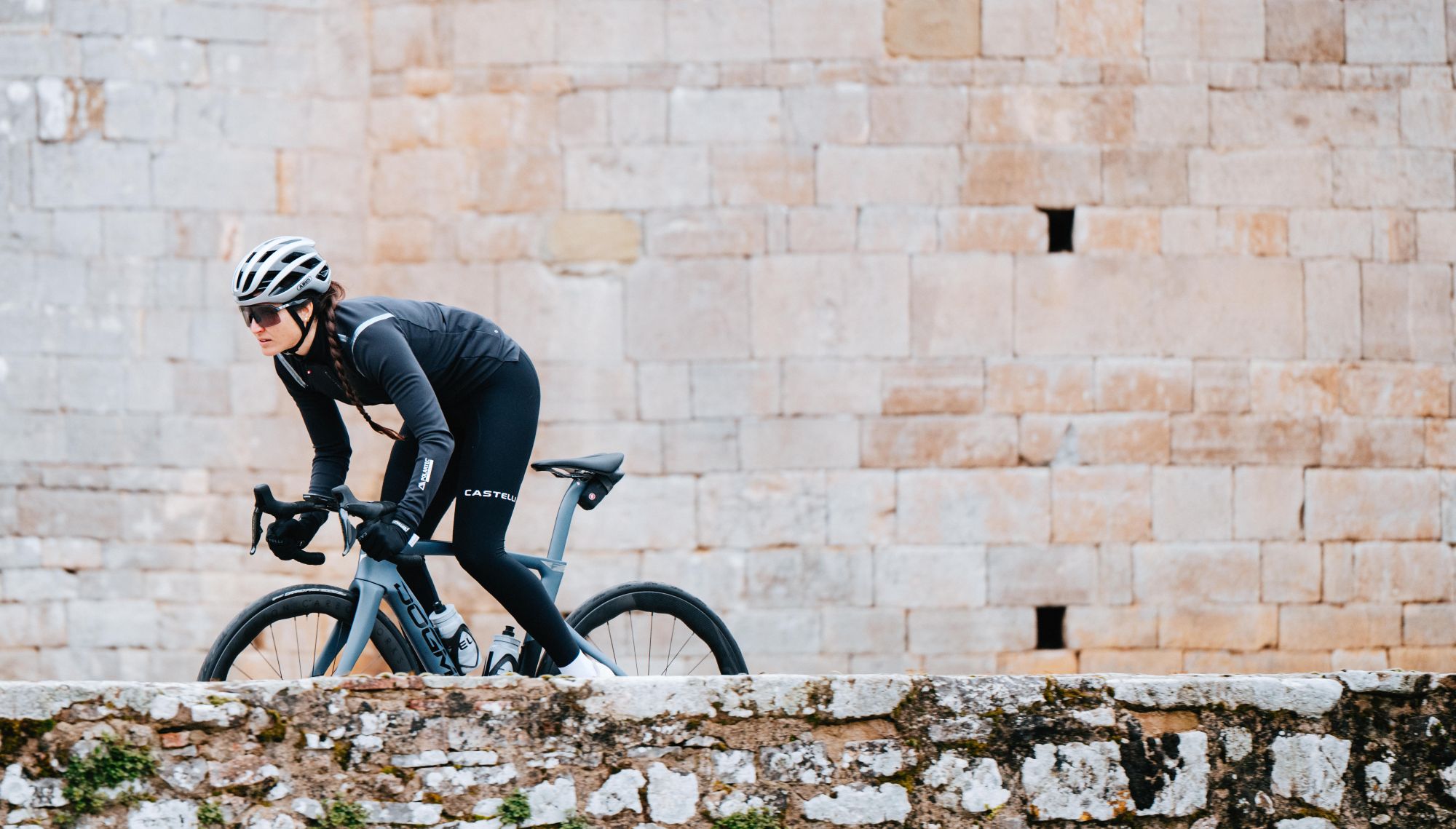
Road jackets: The obsession with aerodynamics and weight
On the road, average speed is high, exposure to the wind is constant, and the position is static and very leaned forward. The cut is ultra-close-fitting ("race fit" or "slim fit") to avoid catching the wind. The front is very short to avoid creasing over the stomach, the back is very long. The fabrics must stretch (4-way stretch) to act like a second skin. Breathability must be maximal because the effort is continuous.
MTB jackets: Durability and freedom of movement
In MTB (All-Mountain, Enduro, XC), the average speed is lower, but accelerations are violent and the risk of crashing or catching on branches is permanent. The cut is looser ("regular fit" or "loose") to absorb the wide movements of the upper body and allow body armour to be worn. The fabrics often incorporate Cordura or Ripstop reinforcements. A large hood compatible with wearing a helmet (over-helmet) is very common.
Gravel jackets: Absolute versatility
Gravel sits at the crossroads of worlds. It requires the comfort of road riding over long distances, but the robustness of MTB for rides through woodland. The cut is in between. These jackets multiply storage spaces (cargo pockets, chest pockets) and come in colours that are often natural and blend into the landscape, but sprinkled with large reflective elements for safety on late rides back on the road.
Commuting jackets: Ultimate visibility and protection
The urban cyclist has radically different needs. They ride in the middle of traffic, sweat little because the effort is moderate (or assisted by an e-bike), and wear their everyday clothes underneath. The cut is loose and straight. Pure waterproofing is king. Visibility is a matter of survival: fluorescent colours, huge 360° reflective panels, and sometimes built-in LED lights.
Frequently Asked Questions (FAQ)
What is the difference between Gore-Tex and Windstopper?
Gore-Tex is a membrane designed to be 100% waterproof while remaining breathable. Windstopper (often made by the same company) is designed to block 100% of the wind. It is highly water-repellent but not fully waterproof in pouring rain, offering far better breathability in return.
How do I wash and care for my waterproof cycling jacket?
Wash your jacket in the machine at 30°C with a standard liquid detergent (never use fabric softener, which clogs the pores of the membrane). Close all zips and velcro fastenings. To reactivate the water repellency (water beading off the fabric), tumble dry the jacket on a low heat for 15 minutes, or use a waterproofing spray (PFC-free DWR treatment).
What is the 3-layer system?
It is the golden rule for staying warm in winter: 1. A base layer (technical underwear worn close to the body) to wick away sweat. 2. A mid layer (long-sleeve jersey) to retain heat. 3. An outer layer (your jacket) to protect you from the wind and rain.
Should I size up for a winter jacket?
Not necessarily. Manufacturers generally cut their winter jackets taking into account the fact that you will wear a jersey and a base layer underneath. Always refer to the brand's size guide. A jacket that is too big will let the cold in.
We will contact you by e-mail when this item is back in stock.


