
Test of the Salomon Genesis S/LAB 2: The elite of trail running under scrutiny
28 août 2026 / Redac , Author


The trail running market is full of models designed to satisfy all types of strides, but the arrival of a new iteration in the S/LAB range from Salomon is always an event closely watched by the community. Synonymous with extreme technicality, thorough research, and high-end materials, this line targets demanding runners. With the Salomon Genesis S/LAB 2, the Savoy brand offers an evolution of one of its popular models, built to face the diversity of natural terrains with increased stability. To check if the feats announced on paper hold true on the trails, the pair was entrusted to Paul, our tester. Here is his detailed analysis, kilometer after kilometer.
Design and first impressions: the elegance of high S/LAB performance
A competition DNA that stands out
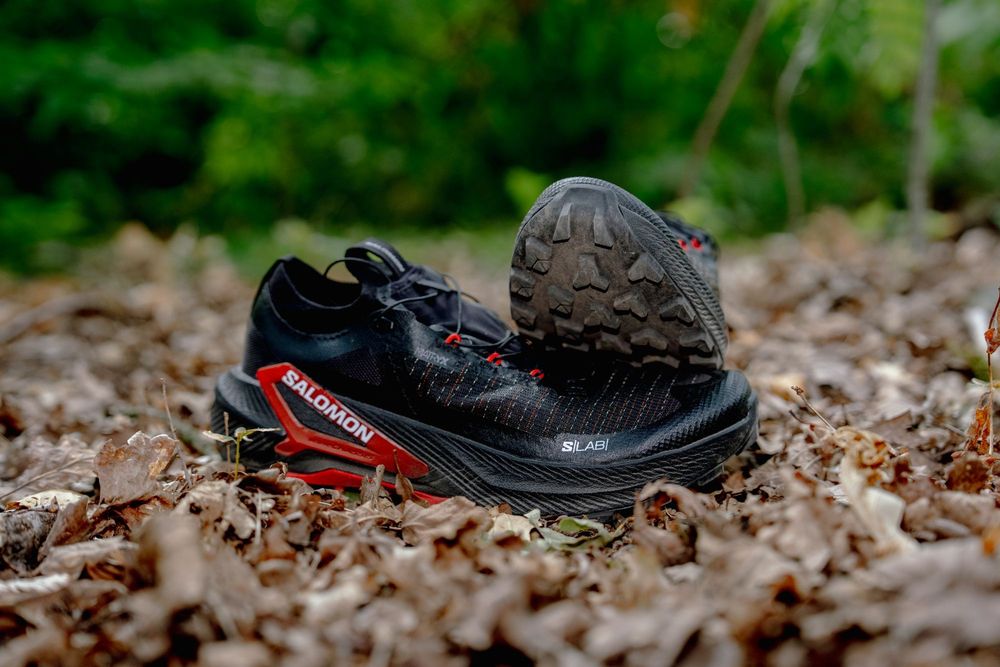
As an equipment enthusiast and regular tester, I’m always especially attentive to the aesthetic and technical choices made by engineers at first visual contact. On this model, the initial glance is extremely positive and the range’s DNA stands out clearly. Very beautiful, you can feel you’re dealing with a high-performance shoe. The upper in Matryx inspires confidence as do the studs. It is also lightweight. The toebox looks solid. It feels like the old one, but better! This subtle yet real evolution shows that the brand has been able to capitalize on the strengths of the first version while considerably refining the lines.
The S/LAB label against marketing promises
The very high-end positioning of this shoe demands absolute rigor in execution, and the marketing promise must not disappoint enthusiasts. On that front, the contract seems fulfilled right away as soon as you have it in hand. The S/LAB label promises a shoe among the best on the market. This is true in terms of finish, choice of materials, and design. It appears to be designed for possible use in wet conditions (material and cleat arrangement). This is exactly what one has the right to expect from a tool made for the harshness of technical and capricious trails. In terms of pure aesthetics, the shoe exudes an undeniable aura of technicality without leaning into visual extravagance or glaring colors. The color scheme is rather sober, the cushioning seems quite generous and reassuring but it keeps a fairly slim overall design. The design is a bit more aggressive than the first version. This controlled aggressiveness in the curves of the sole and upper reinforces the impression of having a precision instrument ready to go.
High expectations before the first trial
Even before lacing the model for the first time, my expectations were focused on the endurance of its dynamic and protective qualities. I mainly expect it not to lose comfort over the course of an outing and to be precise in foot placement. Also a shoe that responds when you want to accelerate. Being confident on all types of terrain. Given this demanding specifications list for any equipment, it would be legitimate to have some concerns before starting. However, my mindset remained surprisingly calm. No, the reputation of the first version was good. The visual preview pleased me well.
Handling and comfort: the sock effect in the service of support
A smooth and effortless foot welcome
Moving from careful observation to trying on is the real first moment of truth. The fit of a technical model must imperatively hug the foot shape without ever constraining it or creating harmful friction points. During the first cold try-ons, the foot welcome proved to be strikingly effective and pleasant. No problem for me. No unpleasant surprise on the chosen size. I have a fairly slim foot, no disturbing or annoying pressure zones. The tongue and gaiter are comfortable. This is an absolutely crucial point: a poorly designed gaiter, too rigid or too tight, can quickly create unbearable inflammatory irritations around the ankle or Achilles tendon. Here, the integration is very gentle and the overall ergonomics have been worked on with obvious care.
The lacing system: practicality and locking
Regarding support, the brand is world-renowned for its proven solutions, and this model does not break the rule of excellence. The famous sliding cable perfectly plays its role to lock the instep precisely. The quick lacing system and the upper allow good support. You can tuck the laces into the top of the tongue, and they do not loosen. This practicality is an undeniable asset when you are on technical trails and refuse to stop to readjust your shoe tension while making an effort.
Toebox and size choice: precision above all
The front area of the foot, often critical for runners after accumulating kilometers and natural swelling, reassured me from the very first seconds as well. I have a slim foot and had no problem. The space allocated to the toes is carefully calculated to guarantee decent comfort without sacrificing the overall precision and dynamism of the model. Moreover, concerning the famous question of the size, I did not have to hesitate or change my usual purchasing habits. To the question of whether you should take bigger or smaller to anticipate shocks on descents, the answer was clear and direct: no, I chose the right size thanks to the Alltricks size guide.
Test in real conditions: under the heatwave and on rough trails
A varied playground to test the sole
To objectively evaluate the capabilities of this Salomon, it was essential to leave the beaten paths and test it on the ground through a serious and representative training block. I therefore planned several outings to analyze its behavior over time. My test volume was situated at a perfectly relevant average for this kind of evaluation, i.e., a Medium commitment (10h in 5 outings). This allows the different materials to work, to very slightly compress the midsole foam, and to observe how the upper reacts to repeated flexions and twists.
The typology of paths was deliberately varied to challenge the sole unit and its adaptability capacity harshly. I mainly walked through damp underwoods, very dry and rugged coastal trails. These heteroclite environments require both pure grip on loose and potentially slippery ground, but also an unfailing hold on hard, rocky, and very uneven ground. My training sessions remained focused on specific effort formats, favoring Short to medium outings (no more than 2h) at medium intensity. This type of format is excellent for judging immediate responsiveness, intrinsic dynamism, and shoe hold without tipping into the extreme fatigue and gait degradation inherent to ultra-trail.
The Matryx upper behavior facing the heat
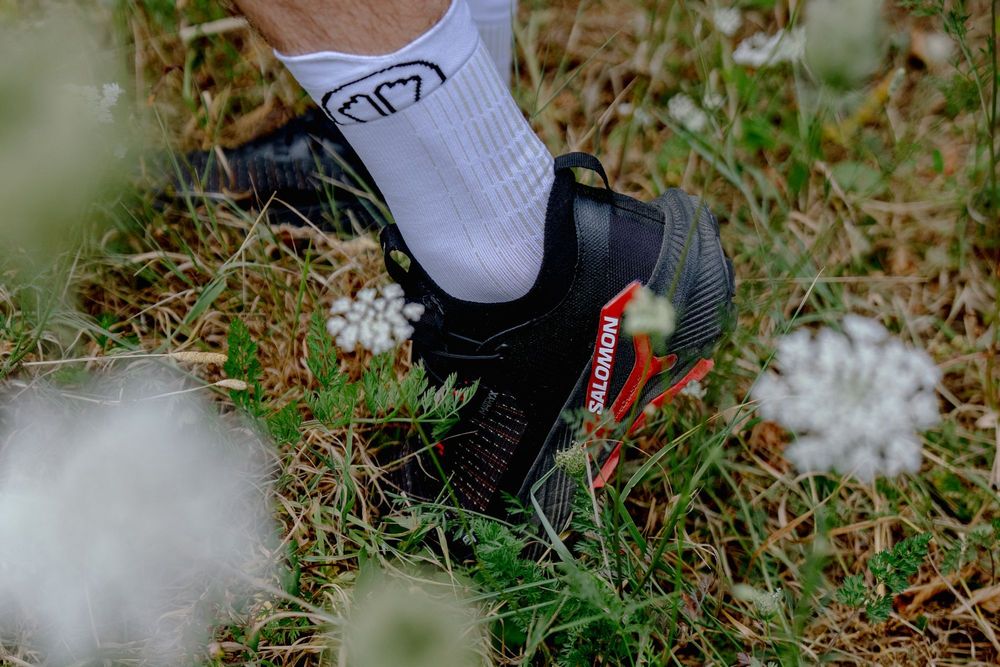
During this summer test period, the weather played a decisive role and allowed me to identify a specificity directly linked to the color chosen by the designers. I ran under dry and sunny weather (heatwave). It seems very suitable for humid conditions. However, in the extreme conditions of this summer, the black absorbs a lot of light and heats up a bit. This dark color, deeply elegant and so characteristic of the visual identity of this elite range, thus presents a slight thermal disadvantage during suffocatingly hot days.
Precisely, when talking about foot thermal management, it's interesting to look at the upper's ventilation capacity. I tested the shoe only in dry conditions. The Matryx should allow good breathability. It is the case, I didn’t feel like my foot was in a steam room. However, choosing black means it can get a bit hot in strong sunlight.
Review after 70 kilometers: confirmed endurance
At the end of this initial training cycle, the assessment of the product’s overall evolution is very satisfactory. After 70km of testing, no change in behavior. The shoe retains all its cushioning and support properties, which validates the high quality of its base design.
Performance assessment: the mastered balance between stability and precision
Rock plate and protection: the essentials are here
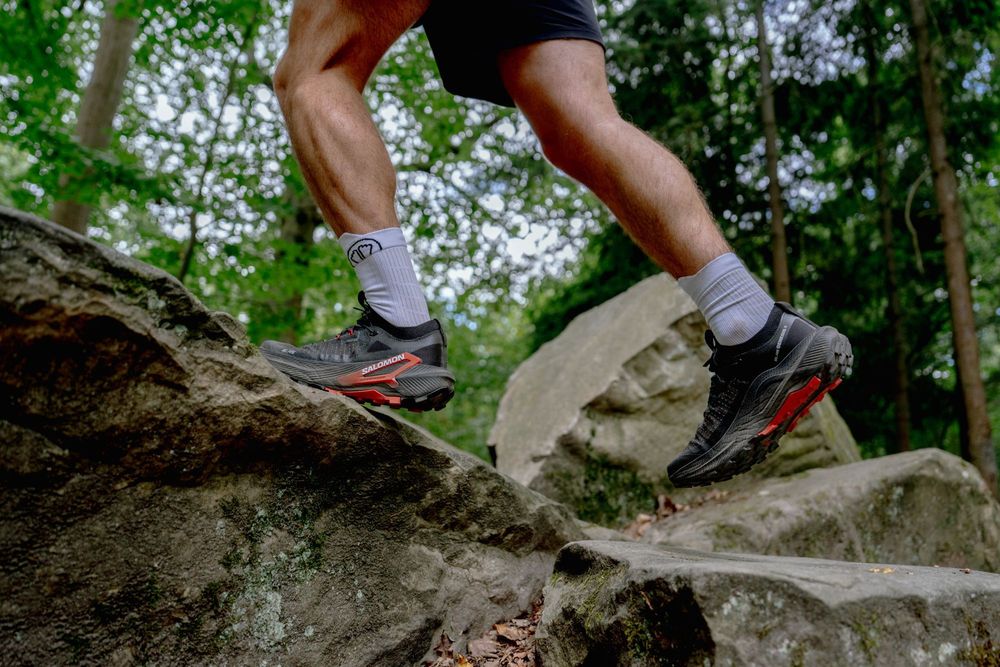
One of the major challenges for a highly technical trail shoe is to successfully protect the runner's foot effectively while guaranteeing excellent proprioception and a fine reading of the terrain's roughness. At the front, the rock plate, without being the most imposing or the stiffest on the current market, fulfills its defensive role very well. I noted good protection but tested in a fairly easy environment. Although I did not have the opportunity to violently hit sharp scree in very high mountains, the structure of the toe appears judiciously reinforced to limit trauma from inevitable impacts against roots or protruding rocks.
The activeCHASSIS put to the test: formidable stability
During the run, the synergy between the foot and the shoe is fundamental, especially in technical descents where the slightest imprecision is costly. On this model, foot hold is a true technical masterclass. There is a very pleasant and secure sock-like effect. If you have chosen the right size, there will be no play, no slight slipping. The heel is also well locked but the foot remains mobile.
The most innovative aspect and the one most highlighted by the brand on this new generation undeniably lies in this stability management. The engineers have integrated a specific chassis, designed to surround the foot during the placement phase. Stability is the brand's big promise with activeCHASSIS. It delivers, it’s very stable on the axis and not evasive during direction changes. The shoe is also quite low and the foam quite firm. This lowered center of gravity is a real asset: it promotes excellent proprioception and smartly keeps the risk of sprain away.
Grip and traction: confident on your footing
The outsole block and the effectiveness of its studs are by nature always scrutinized with the highest demands by trail runners. During my various outings, the grip proved to be totally up to the expectations generated by the brand. No grip issues on dry terrain. No problem either on moist and flat ground. To be seen on more demanding terrain. The rubber's behavior inspires immediate confidence, offering predictable traction that allows you to engage calmly in the tightest curves.
Cushioning and dynamism: preserved terrain reading
Regarding dynamic behavior and fluidity of stride, the overall architecture imposes its own running style. There is little or no rocker on the shoe but you don’t stumble for all that, it’s fluid. It rolls a bit less well when it’s very smooth or on transition parts on asphalt. It's a characterful shoe that requires a real voluntary muscular commitment from the runner, refusing to create an artificial and suffered forward tipping on perfectly flat sections.
The cushioning, on its side, fully assumes its technical identity and heritage. It refuses to totally isolate the runner from his natural environment. It is primarily made to adapt to the terrain not to mask its characteristics. I find it to be good cushioning for my weight. Neither soft nor a plank. This subtle and precise balance effectively absorbs repetitive shocks while preserving a sharp reading of the ground, an essential quality to react in a split second to unforeseen obstacles.
Finally, in terms of liveliness and pure rebound capacity, the observation is nuanced but fundamentally positive for this type of program. It’s not necessarily very dynamic (no plate), the foam rebounds a bit anyway but above all its lightness and the fact that it’s low give a good feeling of dynamism. So it’s above all thanks to its featherweight and reassuring proximity to the ground that the shoe proves playful, agile and lively during sudden accelerations.
Overall assessment and durability: the promising resilience of the Matryx
Over the hours spent scouring trails, my appreciation of this shoe has firmly anchored to become a true certainty. While some sharp models aimed at the elite can sometimes prove extremely demanding or wearing over time for a runner, this one shines through its absolute fairness. Overall I find that it’s an unpretentious and effective shoe, the feel is quite natural. It forgets itself thanks to its support, good flexibility, and gaiter that prevents disruption from stones getting in. It grips enough. It cushions enough but does not erase the terrain, you know where you put your feet. It’s very pleasant. It’s the perfect archetype of a training and race partner you know you can rely on with your eyes closed, without posing endless questions when carefully preparing your gear.
Durability is, rightly, a constant concern regarding products in this prestigious range, often constructed with very light materials to shave precious grams off the scale. Nevertheless, the technology used to weave the mesh quickly dispels any doubts. The Matryx upper promises strong abrasion resistance, which appears to be the case. So far I have observed no foam sagging or premature wear of the studs. Although it will be formally necessary to test this robustness over several hundred additional kilometers and on more abrasive rocks to be sure, the current indicators are all resolutely green. We can calmly anticipate a long and beautiful collaboration with this pair, without fearing premature degradation of its remarkable assets.
In conclusion, this evolution is an undeniable success. It brilliantly consolidates the fundamentals of technical trail while dispensing remarkable comfort and safety, naturally imposing itself as a top choice to face nature with ambition.
Summary Table: Advantages and Disadvantages
| Advantages | Disadvantages |
|---|---|
| Exceptional support and "sock" effect perfectly locking the heel | The black color absorbs heat strongly during heatwave days |
| Excellent directional stability thanks to activeCHASSIS technology | Less fluid stride roll on very smooth asphalt sections |
| Robust, thin, breathable and very light Matryx upper | |
| Effective Quicklace fast lacing system with practical lace holder | |
| Perfect cushioning balance offering precise terrain reading | |
| Ergonomic integration of the gaiter preventing debris intrusion |

Redac
Author
The Alltricks editorial team: passionate experts sharing blog tests and advice on running (10k to marathon), trail, outdoor activities, and of course, all types of cycling.
View his articles


