
Test of the Coros Dura 2 Solar: Is the solar bike GPS computer stepping up?
02 novembre 2026 / Redac , Author


After shaking up the cycling computer market with a first model boasting extraordinary battery life, the American brand returns with a largely revamped version. The model tested is the Coros Dura 2 Solar, the new solar rechargeable bike GPS computer from Coros. On the manufacturer side: Coros, a brand known for its outdoor GPS watches and bike GPS computers. This is the second generation of its bike GPS, succeeding the Coros Dura launched in 2024. Its positioning is clearly high-end, with a fully redesigned look, more premium materials, and even longer battery life for long bike rides.
On paper, the announced evolutions set the tone:
- Improved autonomy, whereas the Coros Dura’s battery life (up to 120 hours GPS announced) was already a reference among bike GPS computers.
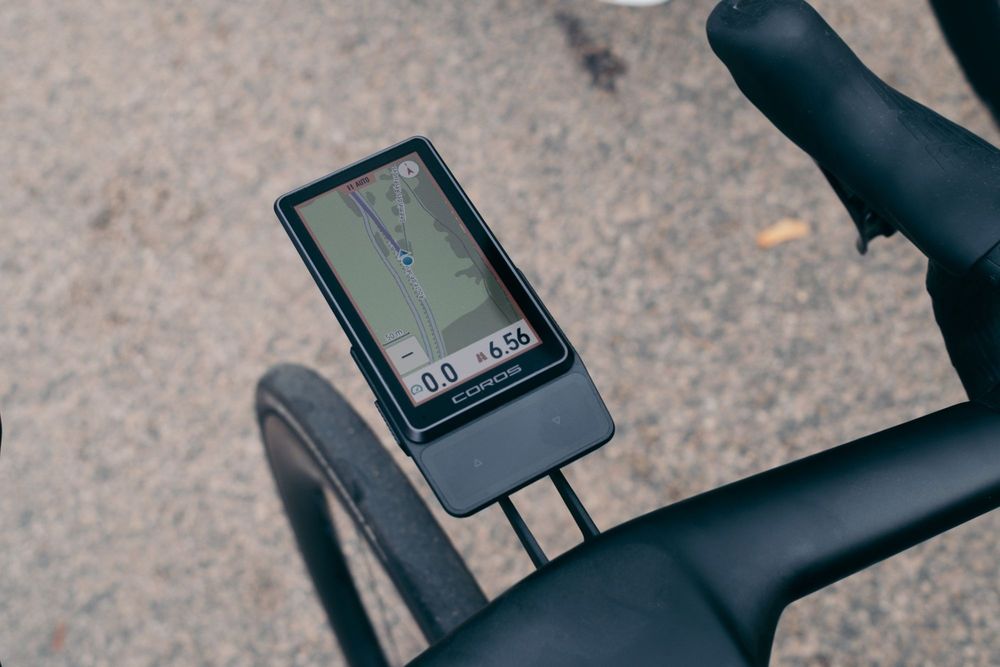
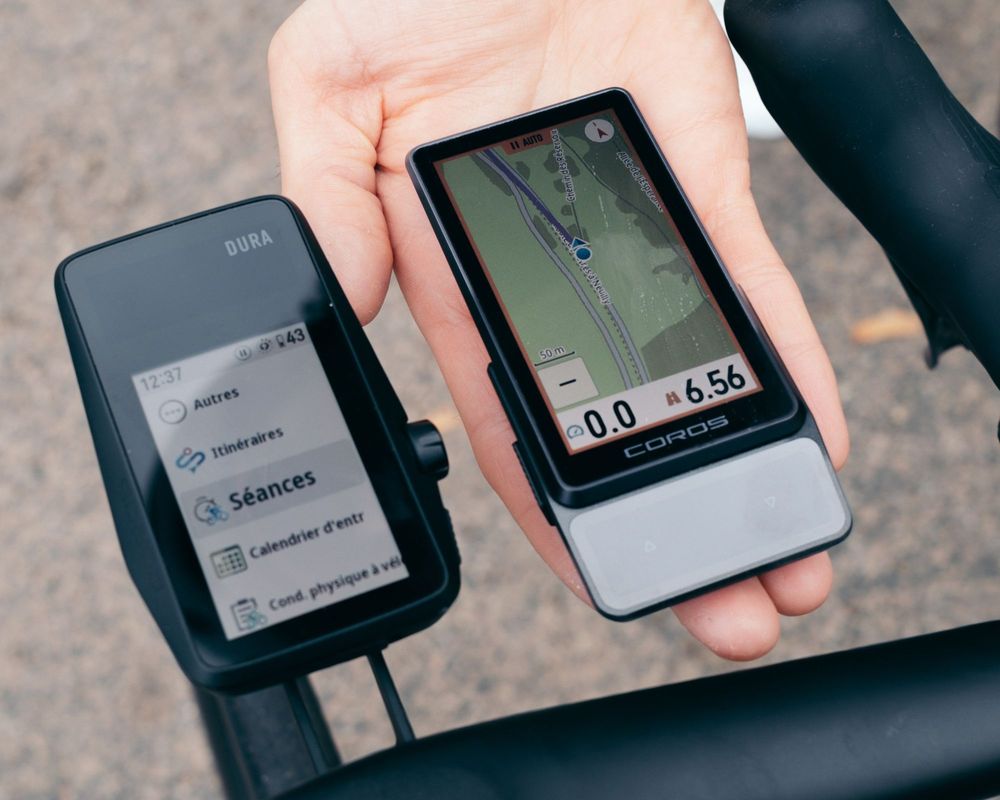
- A larger MIP screen: 3.5 inches compared to 2.7 inches on the Coros Dura.
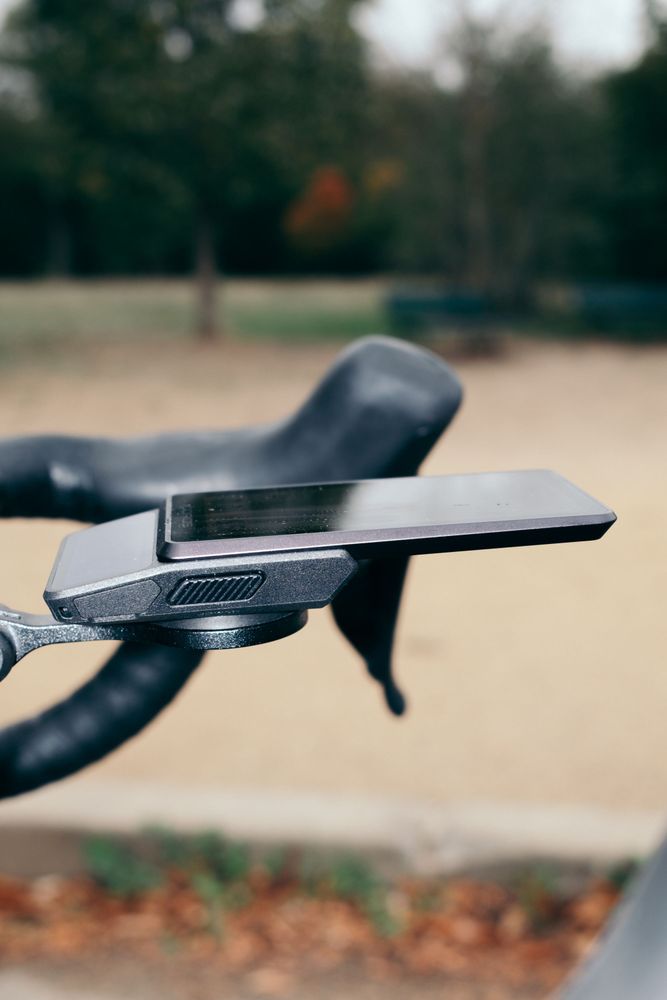
- A new design: the dial disappears in favor of two buttons, one on the left edge and one on the right edge, and two haptic buttons at the bottom of the screen to switch from one data page to another.
To assess this new product with a critical eye, our tester, Clément, doesn’t start from scratch. He has already ridden about 8,000 km over two years using the first-generation Coros Dura. An almost exclusive road use, supplemented by a few gravel rides: this experience allows him to precisely compare the Coros Dura 2 Solar to its predecessor and to measure the reality of its improvements.
Test context: More than 400 kilometers of challenge in the autumn
Before getting to the heart of the matter, it was necessary to confront this second generation with real road conditions and indoor training. I tested the Coros Dura 2 Solar during 5 sessions spread over 10 days, in October 2026, for a total of about 435 km. I mainly used it on the road, during 3 outings (130 km, 80 km, and 110 km) lasting from 3 to 6 hours (including stops), in cool autumn weather (between 5 and 10 °C). I also used it on a home trainer for 2 sessions (55 km and 60 km).
To put this bike computer to the test in a performance-oriented setup, the integration on the handlebars and hardware pairing were examined from the very first wheel turns. The Coros Dura 2 Solar was mounted on a Trek road bike Madone SL7. It was paired with Favero Assioma Pro RS-1 power meter pedals and a Coros heart rate sensor.
When starting this test protocol, I had two specific points of vigilance in mind, inherited from my experience with the first version:
- The screen: the Coros Dura’s 400 × 240 pixel MIP (memory-in-pixel) LCD panel is very readable in all conditions, but is lagging behind the competition.
- The screen-to-body ratio: on the Coros Dura, the solar charging panel located above the screen takes up a significant part of the computer's front face.
Design, ergonomics and screen: A spectacular upgrade and a transformed display
Dimensions, weight and new knobless ergonomics
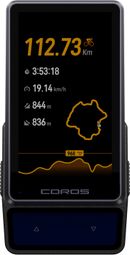
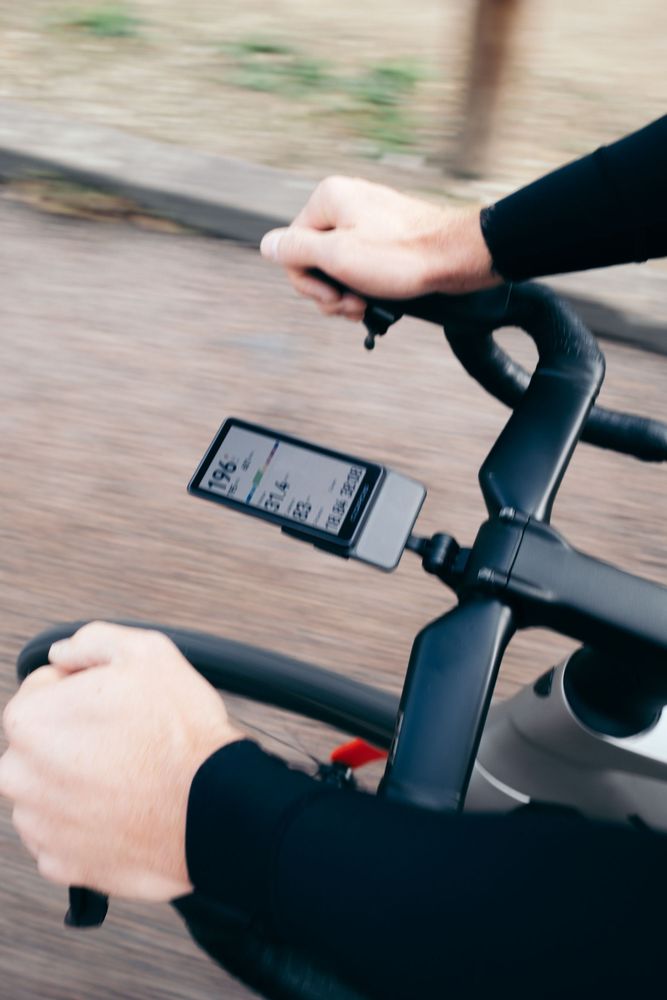
From the moment you open the box and hold it for the first time, the aesthetic change is obvious. The Coros Dura 2 Solar measures 117 × 58 × 17 mm (without the mount) and weighs 99 g, compared to 99.5 × 60.8 × 15.7 mm and 102 g for the Coros Dura. It is therefore 17.5 mm longer and slightly thicker (+1.3 mm), but a bit narrower (−2.8 mm) and 3 g lighter, despite a much larger screen. Its design has been completely revised and modernized: two buttons on each flank of the device and haptic buttons at the bottom of the case, with scroll arrows to navigate menus or change activity screens while riding. The touchscreen is responsive, with or without gloves.
The 3.5-inch MIP screen: readability and touch responsiveness
Faced with criticism about the first generation’s screen size, the visual evolution offers a real leap forward. The Coros Dura 2 Solar upgrades from a 2.7-inch MIP screen to a wider 3.5-inch MIP screen. The readability of this MIP panel remains excellent both in low light (under trees, early morning start, tunnel) and in full sun (open terrain, sun in front or side). Finally, the touchscreen is more responsive than that of the Coros Dura.
Premium finishes, handling and mount compatibility
Regarding build and perceived robustness, the assessment is just as flattering. The materials of the Coros Dura 2 Solar are more noble: aluminum and carbon fiber replace the reinforced polymer of the Coros Dura, with a true sense of upgrading. The overall finish is more qualitative. The only downside: the screen, thinner than that of the Coros Dura, may seem more fragile in case of a fall (a situation I fortunately did not experience during the test).
Regarding handling with autumn or winter gloves, the removal of the side knob is, in my opinion, a sensible choice. Handling of the Coros Dura 2 Solar is clearly improved thanks to the new left button (return to the previous screen) and the two haptic buttons at the bottom of the screen, which replace the knob for scrolling activity screens. And for cyclists already equipped who fear having to change their handlebars, there is no need to buy a new mount: the Coros Dura 2 Solar remains compatible with the original Coros Dura mount as well as Garmin standard mounts, without an adapter.
Navigation, mapping and GPS accuracy: A route recalculation finally up to par
Built-in mapping and offline download
In the field, a high-end computer is primarily judged on its ability to guide the cyclist without hesitation. Regarding map data, no revolution here: the integrated mapping of the Coros Dura 2 Solar remains one of the most precise on the market, thanks to frequent updates via the app. The map display is clear: when following a GPX route, you can zoom in and out on the route or scroll the map with a simple swipe on the touchscreen.
To install offline maps on the computer, you must still go through the Coros app. The map manager divides them by sector: France, for example, is divided into about ten zones, all downloadable for free. Downloading is only possible via Wi-Fi (impossible over the mobile network): so be sure to anticipate before you leave.
Turn-by-turn guidance and speed of route recalculation
Where the computer was really tested is its responsiveness during unexpected direction changes. This is one of the big improvements compared to the Coros Dura: turn-by-turn guidance remains effective, and route recalculation is now much faster and more accurate. If you miss an intersection, the Coros Dura 2 Solar recalculates the route in 3 to 5 seconds and offers either to rejoin the initial track or to "cut across" to find it further along. A "Cancel rerouting" option also allows you to stop the guidance when you no longer need the initial trace: ideal at the end of a ride if you know a shortcut home.
Processor power and GPS track accuracy
The processor of the Coros Dura 2 Solar has been optimized: the computer turns on faster and, above all, recalculates routes much faster than the first-generation Coros Dura. Test conducted in the Chevreuse Valley, with medium-quality 4G coverage. At the same time, satellite lock-on at startup is almost immediate. GPS signal acquisition takes between 10 and 30 seconds depending on the departure location. I measured these times in Paris (17th district), in a dense urban environment, and in the Chevreuse Valley.
On the map, the distinction between roads, paths and trails is well detailed. By paying attention, the risk of taking the wrong path is very low. In case of error, the GPS warns you (audible and/or visual alert), offers to turn around, then recalculates the route if you continue in another direction, until an alternative to rejoin the initial route is found.
GPX route import and remaining limitations
Upstream trace management habits remain unchanged. During this test, I used GPX routes created on Strava and imported into the Coros app. Transfer to the computer takes only a few seconds, and I encountered no tracking problems during rides. The method remains the same as on the Coros Dura: you import the GPX file into the Coros app, which sends it to the bike GPS; the route is then accessible in the "Routes" menu.
In the Coros Dura test, Baptiste reported two negative points: route recalculation only if the computer is connected to the phone, and route creation impossible from the computer and not very intuitive from the app. I was not confronted with the recalculation limitation depending on the phone during this test: this point remains to be confirmed with longer use. However, creating or modifying a route directly from the computer is still not possible.
Barometric altimeter and climb tracking
Finally, when the road rises, the barometric altimeter and climb manager respond. The barometric altimeter proves reliable and climb tracking (equivalent to Garmin’s ClimbPro) works like on the Coros Dura: at the foot of each ascent, the computer announces it and displays the number of climbs remaining on the route, the distance to the summit, and the positive elevation gain of the section. The redesigned activity screen makes this data more readable, and a dedicated page allows you to follow the ascent in its entirety.
Connectivity, ecosystem, and interface: Coros simplicity always on point
External sensors, synchronization, and updates
One of Coros's great strengths lies in its streamlined and quick-to-learn ecosystem. In terms of hardware connectivity, the Coros Dura 2 Solar connects via ANT+ and Bluetooth to all essential sensors: heart rate sensor, power sensor, and cadence sensor, as well as to the smart trainer via ANT+.
What about exporting workouts to third-party apps? The Coros Dura 2 Solar is compatible with the main training platforms, and synchronization happens automatically as soon as the activity is recorded. If an activity does not upload automatically, you just need to open the Coros app, which handles the connection to your performance tracking platform (Strava, Nolio, etc.). Additionally, Coros provides regular software maintenance: firmware updates are offered when you open the app and install via Bluetooth or Wi-Fi (faster).
Menu navigation, alerts, and voice command
In use, the software interface maintains this philosophy based on immediate efficiency. The menus, already intuitive on the Coros Dura, remain the same on the Coros Dura 2 Solar: power on, select activity, start. The number of clicks and the elements displayed on the screen are identical to the Coros Dura: no adaptation time is needed. Data screens are easily customizable from the Coros app, which makes setting up the device before your ride straightforward. While riding, notifications and alerts are well integrated into the operation, with the choice of a sound notification, a visual alert on the GPS screen, or both.
However, the voice command seemed ineffective to me on the bike: the GPS poorly recognizes requests, and you ultimately have to perform the action manually.
Battery life and charging: Does the 100-hour claim hold up?
Real-world consumption and the contribution of solar charging
With the switch to a larger 3.5-inch MIP screen, one might have feared an impact on the device’s endurance. Yet, the numbers recorded in the field are impressive. Coros claims over 100 hours of battery life for the Coros Dura 2 Solar. After 10 days of testing, I couldn’t fully verify this figure, but my readings show the promise is credible: on a 130 km ride (about 4 h 30 of effort, 5 hours total, 28.5 km/h average speed, and 900 m of elevation gain), the battery only lost 7.5% of its charge. The activity consumed 8.6% of battery, of which 1.1% was compensated by solar charging, despite a gray sky and 7 °C throughout the ride. Note: the device was connected to a power sensor and a heart rate sensor, with the screen at maximum brightness, and it stayed on (activity simply paused) during stops.
USB-C charging time and energy management
When you eventually have to use a power outlet, charging the Coros Dura 2 Solar is done via a USB-C port: expect between 2 hours 30 minutes and 3 hours for a full charge, with solar charging supplementing the battery while riding. There is no dedicated power-saving mode, but you can extend battery life by reducing screen brightness, turning off notifications, and lowering the frequency of GPS point recording. With over 100 hours of battery life advertised, these energy-saving adjustments should remain rarely used.
Verdict and summary of my Coros Dura 2 Solar test
Price positioning and buying advice
At the end of the day, this technological and hardware upgrade comes with a marked price repositioning. The price is consistent compared to the competition, considering the premium positioning of the Coros Dura 2 Solar (premium materials, enhanced user experience, and modernized design). Sold for €499 (without mount), it nonetheless represents a significant increase compared to the Coros Dura, priced at €289.
So, should you go for this new model if you already own the first one? If your Coros Dura still works perfectly, there’s no rush: it’s better to wait before upgrading to the Coros Dura 2 Solar. However, if you’re looking for a premium GPS bike computer with very long battery life, it deserves your full attention. The Coros Dura 2 Solar is especially well suited for road performance, gravel, and bikepacking—activities where its autonomy and navigation make a real difference.
Strengths and weaknesses
| Strengths | Weaknesses |
|---|---|
| A completely redesigned, lighter, and more premium design | Still impossible to create or modify a route directly from the GPS |
| A 3.5-inch MIP screen, larger, more readable, and more responsive | Unreliable voice command on the bike |
| More than 100 hours of battery life claimed, still impressive, supported by solar charging | |
| The Coros app and pairing of external sensors remain very simple |

Redac
Author
The Alltricks editorial team: passionate experts sharing blog tests and advice on running (10k to marathon), trail, outdoor activities, and of course, all types of cycling.
View his articles


