
SRAM Red AXS vs Shimano Dura-Ace Di2: The clash of the peloton titans
15 juillet 2026 / Redac , Author


At the top of the cycling hierarchy, where every gram counts and the slightest fraction of a second separates victory from oblivion, sit two undisputed legends: SRAM Red AXS and Shimano Dura-Ace Di2. These are not just simple drivetrains; they represent the absolute technological pinnacle, the exclusive armament of the World Tour peloton and the dream of all gear purists. Designed for professionals and created with no budget compromises, these two 12-speed disc brake groupsets embody the mechanical and electronic perfection of their respective brands. But while they share this visceral quest for ultimate performance, they face off with radically different weapons. Between the minimalism of the American's 100% wireless system and the surgical precision of the Japanese giant’s semi-wireless setup, between sequential logic and traditional ergonomics, which vision truly dominates on the asphalt? We break down these two sacred monsters from SRAM and Shimano to help you decide on excellence.
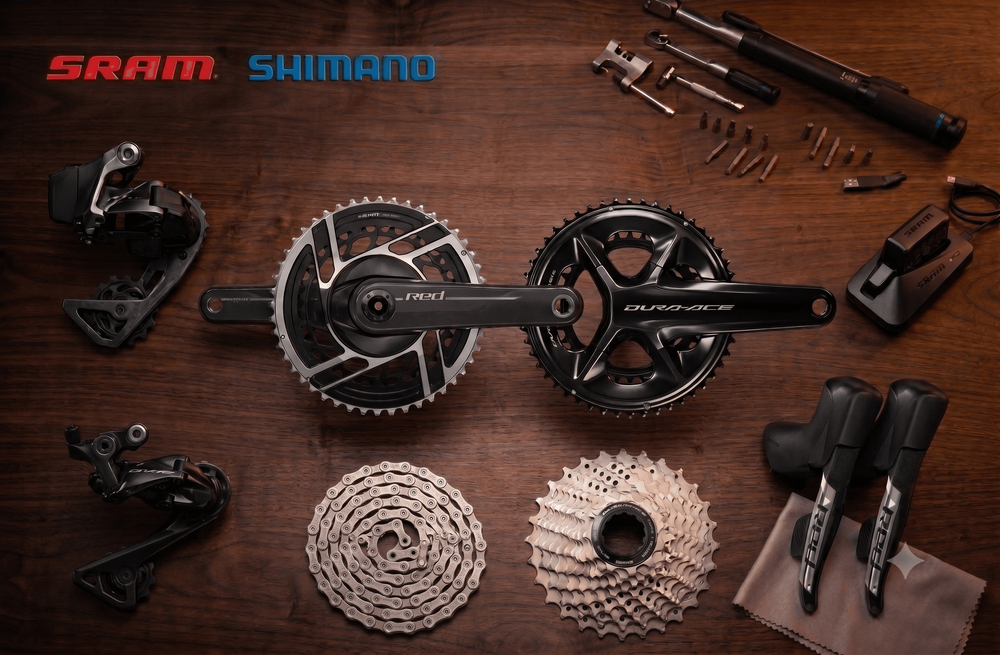
Installation and Connectivity: Wireless vs Semi-Wireless
The approach of the two brands regarding power supply is diametrically opposed, and this often makes the decision.
- SRAM Red AXS (100% wireless): Each derailleur has its own removable battery, and the shifters operate with button batteries (CR2032). The major advantage is convenience: if the rear derailleur’s battery dies during a ride, you can swap it with the front derailleur’s to get home. You can also easily slip a 24g spare battery into your pocket.
- Shimano Dura-Ace Di2 (Semi-wireless): The shifters are wireless (also button batteries), but the derailleurs are connected by cables to a central battery, usually hidden inside the seat post. This makes the initial setup a bit more complex. To recharge it, you have to plug a proprietary cable directly into the rear derailleur — which requires having a power outlet near where you store your bike.
Ergonomics and shifting logic
Ergonomics is a matter of personal preference, but the two systems are distinguished by their philosophy.
| Feature | Shimano Dura-Ace Di2 | SRAM Red AXS |
|---|---|---|
| Default logic | 2 buttons on the left (front), 2 on the right (rear) | 1 button on the left (easier), 1 on the right (harder) |
| Chainring shifting | Left buttons | Simultaneous pressure on both buttons |
| Hood ergonomics | Thin, slightly curved inward | Completely redesigned in 2024, more compact |
| Satellite buttons | Up to 2 pairs, wired | Up to 8 "Blips", fully wireless |
Note: If you prefer SRAM’s logic but ride Shimano (or vice versa), the mobile apps from both brands (E-Tube and AXS) allow you to fully reconfigure button assignments. The 2024 SRAM Red also added "Bonus Buttons" on top of the hoods, similar to those Shimano has long offered, to shift with your hands on top of the bars or control your GPS.
On the road: shifting precision and braking
This is where the battle is fiercest.
Shifting: Shimano keeps its crown (just barely)
Historically, Shimano was clearly superior. Today, with SRAM's front derailleur redesign, the gap has significantly narrowed.
The Dura-Ace Di2 remains the undisputed king of smoothness and speed, especially on shifting chainrings under load. The gears change almost imperceptibly. The SRAM Red is very fast, but the feedback is more "mechanical" and slightly noisier.
Braking: The advantage goes to SRAM
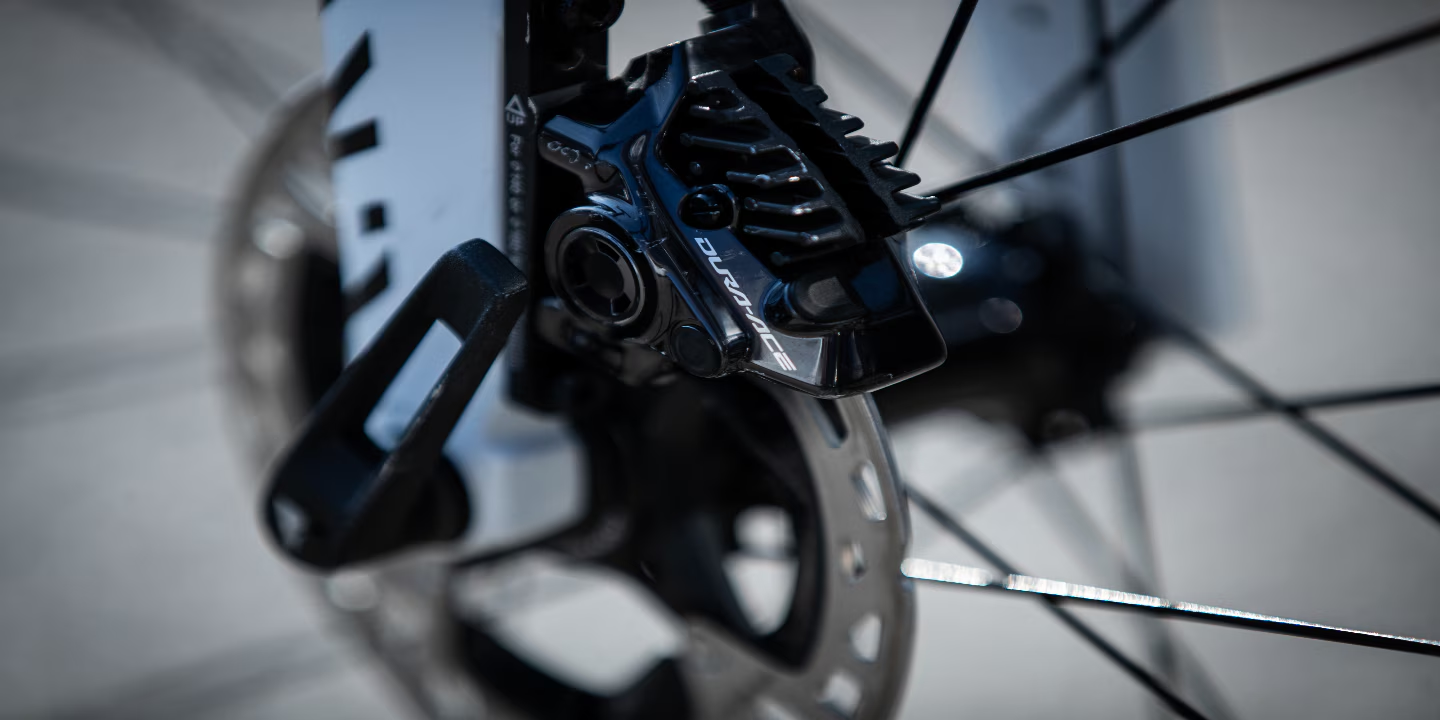
This is the big surprise of the 2024 iteration. SRAM completely redesigned its calipers and master cylinders (still using DOT fluid, versus mineral oil for Shimano). The result is braking literally at "one finger" from the hoods. Shimano’s braking (Servo Wave) remains exceptional, but testers agree the new Red offers a lighter feel and better pad clearance (no more disc rubbing noise after heavy braking on descents).
Gear ratios, weight and power meters
Both groups show almost identical weight on the scale (around 2.5 kg for the complete group with power meter), SRAM having slimmed down by more than 150g on its latest version.
- The cassette standard: Shimano uses an 11-tooth start, which offers a slightly smoother pedaling feel. SRAM uses a 10-tooth cog (requiring an XDR freehub body).
- Power meter: The Quarq power meter of the SRAM Red is incredibly precise. Be careful though: with SRAM Red, the chainrings and power meter are machined from a single aluminum block. If your chainrings are worn, you must buy the whole set again (around €600), although SRAM offers a recycling program at half price. With Shimano, chainrings can be changed independently of the power meter.
Maintenance and autonomy
- Autonomy: Shimano's large central battery easily lasts 1,000 km between charges. SRAM's small external batteries provide around 60 hours of riding. Shimano wins on duration, but SRAM wins on ease of recharging (the USB charger is tiny).
- Long-term reliability: Mechanics tend to praise the durability of Shimano's bearings (24mm axle) and the easy maintenance of their mineral oil. However, SRAM's 100% wireless system eliminates the risk of pinched or unplugged cables in very integrated modern frames.
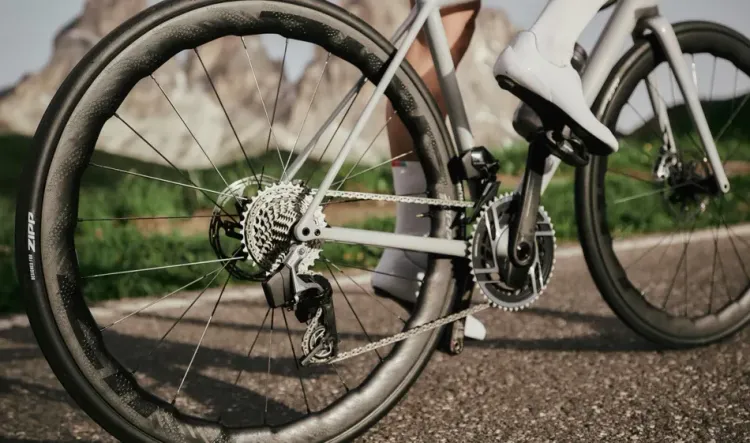
Comparison table: SRAM Red AXS vs Shimano Dura-Ace Di2
| Feature | SRAM Red AXS | Shimano Dura-Ace Di2 (R9200) |
|---|---|---|
| Connectivity | 100% wireless | Semi-wireless (derailleurs connected to a battery) |
| Speeds | 2x12 speeds | 2x12 speeds |
| Estimated weight (with sensor) | ~ 2,496 g | ~ 2,579 g |
| Power supply | Removable batteries on each derailleur | Internal central battery (seatpost/frame) |
| Autonomy (derailleurs) | About 60 hours of riding | About 1,000 km |
| Brake fluid | DOT 5.1 | Mineral oil |
| Cassette (smallest sprocket) | Starting at 10 teeth | Starting at 11 teeth |
| Freehub body | SRAM XDR | Shimano HG (11/12v) |
| Power meter | Integrated directly into the chainrings (single unit) | Integrated into cranks (separate chainrings) |
| Satellite buttons | Up to 8 "Blips" buttons (wireless) | Up to 2 pairs of buttons (wired) |
The Verdict: Which one to choose?
There is no bad choice at this price level (count between €2,800 and €3,200 for either).
Choose the Shimano Dura-Ace Di2 if
... you are looking for absolute mechanical perfection and unmatched smoothness. The Japanese giant retains its throne when it comes to speed and silence in shifting. Thanks to Hyperglide+ technology, even during full acceleration or under extreme stress, the chain shifts from one sprocket to another with surgical precision and remarkably quiet operation. It is also the rational choice for serious riders: since the power meter is independent from the chainrings, replacing worn parts is much less expensive than with its competitor. Regarding autonomy, the central battery hidden inside the seatpost offers monumental peace of mind by easily exceeding 1,000 kilometers of range. Finally, racers loyal to traditional ergonomics will instantly find their bearings with the two classic buttons per shifter, offering clear tactile feedback for full control.
Choose the SRAM Red AXS if
... you prioritize wireless innovation, modern ergonomics, and ultimate braking. Its 100% cable-free ecosystem is a true blessing for traveling cyclists or those who build their own bike. The removable batteries not only allow you to carry a lightweight spare charge in your pocket, but also to swap them in a flash roadside. With this new generation, SRAM has completely redefined braking standards: redesigned from the ground up, it offers phenomenal power controllable with one finger, without any annoying noise. In a race, the sequential shifting logic inspired by Formula 1 proves strikingly obvious, avoiding any manipulation errors under effort. Finally, data geeks will appreciate the AXS app, unquestionably the most advanced on the market for analyzing and customizing your ride.

Redac
Author
The Alltricks editorial team: passionate experts sharing blog tests and advice on running (10k to marathon), trail, outdoor activities, and of course, all types of cycling.
View his articles


