
SRAM Force AXS vs Shimano Ultegra Di2: The battle of the road heavyweights
10 juillet 2026 / Redac , Author


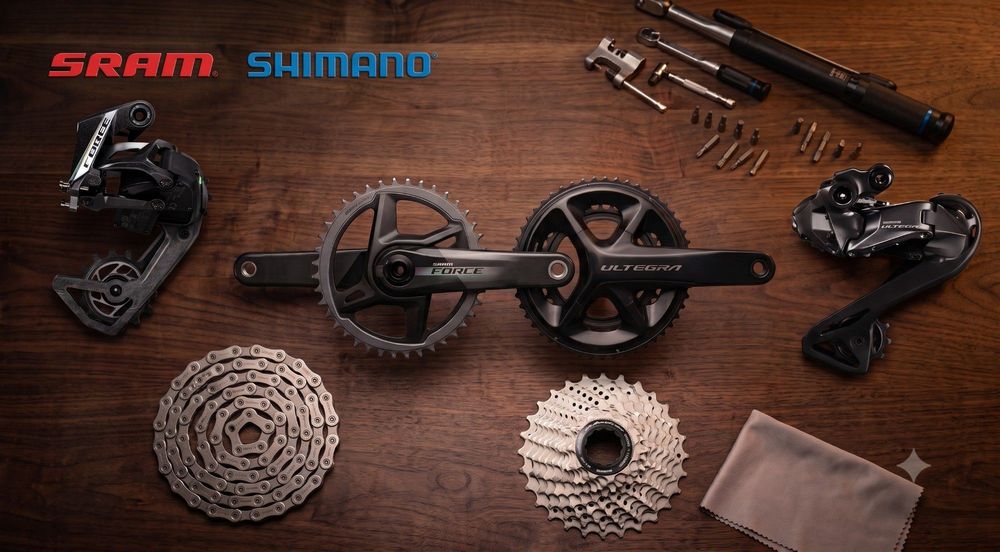
If the iconic SRAM Red and Shimano Dura-Ace represent the absolute technological pinnacle, the Force AXS and Ultegra Di2 stand as their direct heirs and the true workhorses of the peloton. Featuring the same cutting-edge innovations as their prestigious predecessors, these two references embody the perfect balance point for uncompromising cyclists. It’s the arsenal of choice for relentless racers, time-trial hunters, and meticulous sportive riders who refuse any compromise on their machine. 12-speed groups with discs offering formidable performance, directly inspired by professional models. But on the asphalt, which philosophy wins? Cables or wireless? Mineral or DOT? We get our hands dirty to sort out these groups from the two giants SRAM and Shimano.
Cables and Power, the dread of running dry
- SRAM Force AXS (100% Wireless): The mechanic’s dream. SRAM removed absolutely all the wires. The shifter hoods have watch batteries (CR2032) and each derailleur carries its own removable battery. It’s clean, aesthetic, and perfect for building your bike yourself on a rainy Sunday.
- The sweat point: The battery life is about 60 hours (1000 km). If you’re the forgetful type and you run out of rear battery power at the foot of Mont Ventoux, you can swap the front derailleur’s battery with the rear one in a few seconds flat. A pit stop worthy of F1.
- Shimano Ultegra Di2 (Semi-wireless): The shifter hoods have no wires, but your two derailleurs are electrically connected to a big energy barrel hidden in your seat tube.
- The serenity point: Once charged, the Shimano battery lasts forever (several months or 1500 to 2000 km). You plug in the bike two or three times a year and you don’t think about it anymore. But beware, if you forget to charge it, it’s guaranteed to run dry with no backup solution on the roadside.
The Shifting Logic (Paddles vs Buttons)
At 180 beats per minute, with lactic acid up to your ears, your brain can’t think anymore. How do you shift gears?
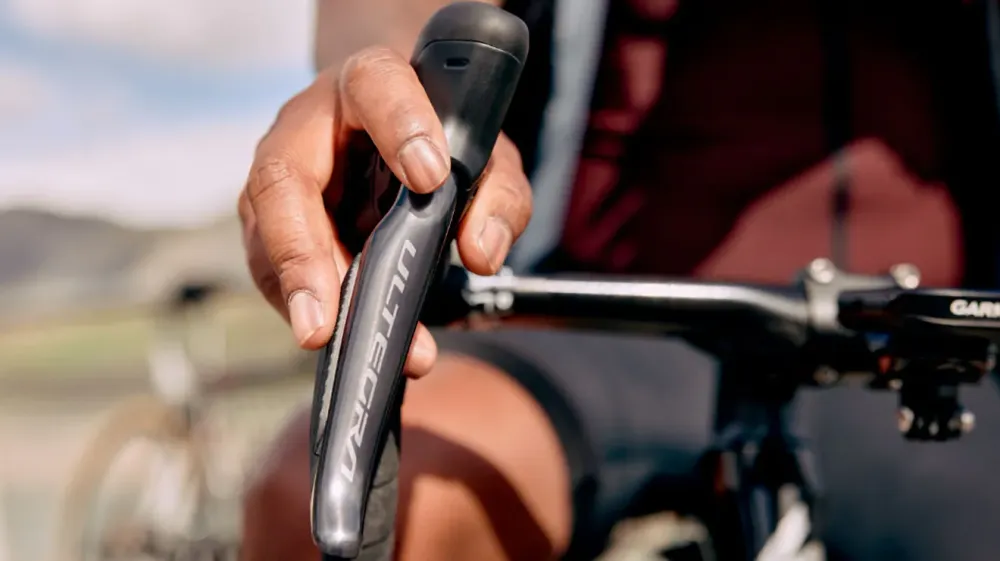
- SRAM Force (The F1 method): A big paddle behind each brake lever. Click right, the chain goes down (harder). Click left, it goes up (easier). Press both at the same time, the front derailleur changes chainring. It’s brilliantly intuitive, impossible to miss even with thick neoprene gloves in winter.
- Shimano Ultegra (The surgical method): Shimano keeps two distinct buttons on each shifter. On paper, you could get mixed up in winter. In reality, the speed and silent execution of Di2 are in a class of their own. The chain slides from one cog to another with an almost insolent smoothness. Special mention to the Ultegra front derailleur: it shifts the big chainring under full load without you hearing it even cough. Moreover, Shimano integrates a hidden button at the top of the hoods, also programmable, which allows you to add different functions (gear changes, actions on the GPS, etc.) without letting go of the handlebars.
The Battle of Teeth (Tradition vs Mathematics)
- The classic stronghold (Ultegra): Shimano is a lover of traditional road biking. You have your good old chainsets 52/36 or 50/34, paired with 11-30 or 11-34 cassettes. The system is known, the gear steps are perfect to find your ideal cadence. No fuss.
- The "X-Range" equation (Force AXS): SRAM broke the codes. The chainring becomes very small (48/35 and 46/33 are usually mounted by default on new bikes) but the cassette starts with a tiny 10-tooth cog (10-28 or 10-33). Result? With a 48x10, you go faster on a mountain descent than with a classic 52x11. It’s disorienting at first, but the range of use is formidable. And for those who want other gear ratios, many options exist in custom builds: from classic 50/34 and 52/36, to massive 54/38 or 50/38.
- SRAM Bonus: The brand-new Force generation (E1) integrates the two chainrings into a single machined carbon block. It’s magnificent, ultra-rigid, and it has considerably improved the smoothness of chainring shifting. Moreover, like the Rival group, the AXS ecosystem lets you run the Force as a single chainring or pair it with XPLR or MTB components.
Braking, mineral oil versus DOT
- Shimano Ultegra (Mineral Oil): Shimano uses mineral oil, which does not absorb moisture and does not damage your frame’s paint. The new Ultegra R8100 calipers benefit from Servo Wave technology borrowed from mountain biking, and have increased the space between the pads by 10%. No more disc rubbing noise after grabbing the brakes hard in a tight corner. It’s the no-fuss caliper par excellence.
- SRAM Force (DOT 5.1): Like in your car, SRAM uses DOT fluid. It handles heat like no other, but it’s hydrophilic: it absorbs moisture over time, requiring a thorough annual bleed. On the other hand, SRAM’s brake “feel” is often praised: it’s less binary and more controllable than Shimano’s.
The heart of the matter (Watts, Ergonomics and Weight)
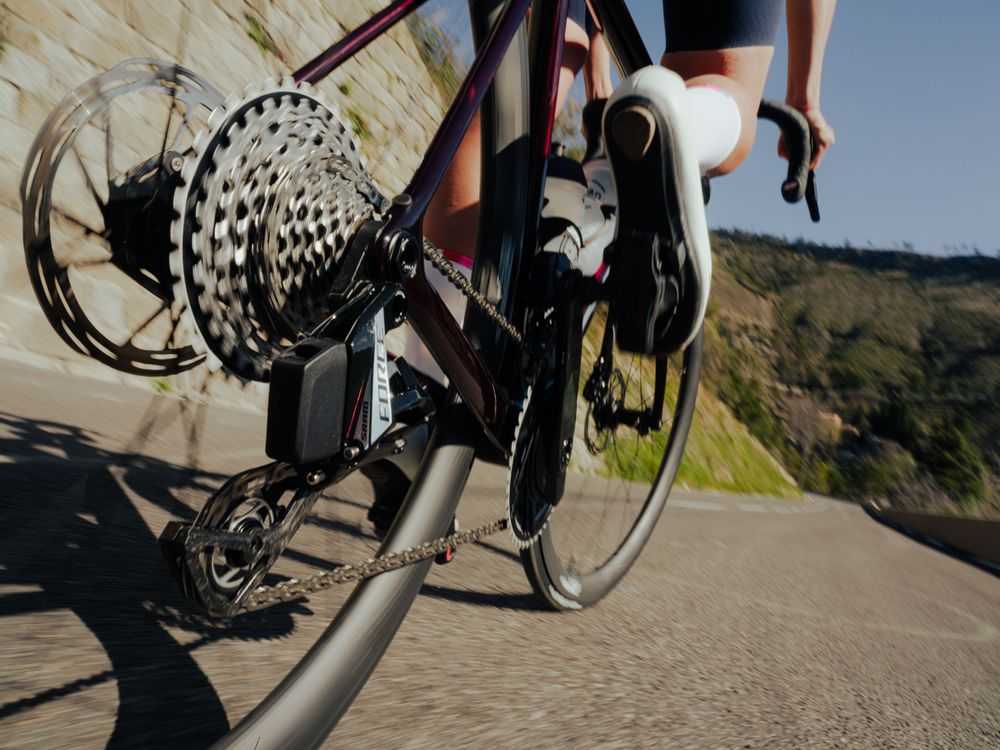
- Power meter: SRAM has a serious advantage by offering its integrated Quarq sensor at an extremely competitive price. The big novelty with this E1 group is that the Quarq power meter housed in the chainring block can now be removed. This allows you to change front gearing while keeping your power meter (you just need to have the specific tool SRAM Thread Mount Removal Tool, sold separately). On the Ultegra side, Shimano’s sensor represents a heavier investment, often pushing cyclists toward third-party solutions like 4iiii.
- Weight and Look: Since its update (E1 version), the SRAM Force group has slimmed down its brake hoods (a true delight for small hands) and sports an iridescent carbon finish that’s pleasing to the eye. Both groups weigh approximately 2700-2800 grams (Force has caught up to Shimano thanks to its machined carbon parts). Neck and neck on the scale.
Summary Table
| Feature | Shimano Ultegra Di2 (R8100) | SRAM Force AXS (E1) |
|---|---|---|
| Wiring | Semi-wireless | 100% wireless |
| Battery Management | 1 central (~1500+ km) | 1 per derailleur (~60h of riding) |
| Road Gearsets (2x) | Classic (ex: 50/34, 11-30 or 11-34) | X-Range (ex: 48/35 or 46/33, 10-28 or 10-33) |
| Chainring Shifting | Electronic auto-trim (ultra fast) | Yaw technology (very stiff machined chainring block) |
| Ergonomics | Classic buttons + 1 hidden button | Intuitive paddles (like in car racing) |
| Brake Fluid | Mineral Oil | DOT 5.1 fluid |
| Power Meter | Optional | Integrated Quarq option (very affordable) |
The Verdict
With these war machines, you can't make a "bad" choice. But here is who they are made for:
Choose the Shimano Ultegra Di2 if
You’ve got chain oil running through your veins, you’re looking for the smoothest, fastest, and quietest shifting on the market. You want brakes that are easy to maintain with mineral oil, and you like the idea of charging your battery three times a year and never thinking about it again. This is Japanese reliability in all its glory.
Choose the SRAM Force AXS if
You want a super modern bike, "zero cable," with easy setup. You’ll love the amazing intuitiveness of the shift paddles, the premium look of the monoblock chainrings, and the ultra-affordable access to a top-notch integrated power meter. It’s also the golden choice if you want to keep the door open to hybridization with gravel components!

Redac
Author
The Alltricks editorial team: passionate experts sharing blog tests and advice on running (10k to marathon), trail, outdoor activities, and of course, all types of cycling.
View his articles


